
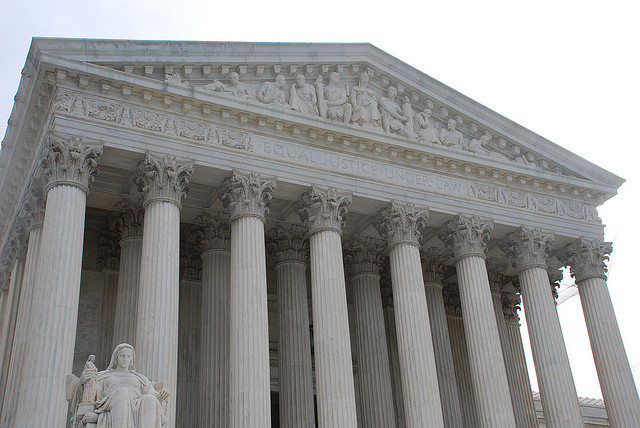
 The US Supreme Court announced Dec. 15 that it will not hear a case challenging the federal illegality of marijuana. The case, Canna Provisions v. Bondi, was brought by four Massachusetts commercial cannabis growers. The businesses alleged that the Controlled Substances Act exceeds the powers of Congress under the Commerce Clause and violates the right to due process under the Fifth Amendment.
The appeal to the Supreme Court was supported by amicus briefs from the Cato Institute, a libertarian think tank, and the Americans for Prosperity Foundation, founded by the Koch brothers. However, the case failed to get the four votes needed for certiorari.
Keith Stroup, legal counsel for the National Organization for the Reform of Marijuana Laws (NORML), said:
This result is not altogether surprising. Courts have rarely provided relief to those of us who believe that marijuana prohibition violates our civil and Constitutional liberties. It is… up to Congress to repeal this destructive and discriminatory policy.
Members of the court have previously expressed skepticism over the federal government’s treatment of marijuana sale and production. While cannabis is criminalized under federal law, agencies have generally maintained a policy of non-enforcement, allowing states such as Massachusetts to pass laws regulating the substance. In 2021, Justice Clarence Thomas wrote:
Once comprehensive, the Federal Government’s current approach is a half-in, half-out regime that simultaneously tolerates and forbids local use of marijuana. This contradictory and unstable state of affairs strains basic principles of federalism and conceals traps for the unwary… [O]ne can certainly understand why an ordinary person might think that the Federal Government has retreated from its once-absolute ban on marijuana.
The current case started in the US District Court for the District of Massachusetts, which dismissed the case for failure to state a claim. Plaintiffs appealed to the US Court of Appeals for the First Circuit, which upheld the lower court’s decision under the Commerce and the Necessary & Proper clauses of the Constitution.




Recent comments
13 weeks 1 day ago
13 weeks 4 days ago
21 weeks 5 days ago
22 weeks 6 days ago
23 weeks 4 days ago
28 weeks 6 days ago
35 weeks 2 days ago
35 weeks 2 days ago
38 weeks 3 days ago
39 weeks 2 days ago